

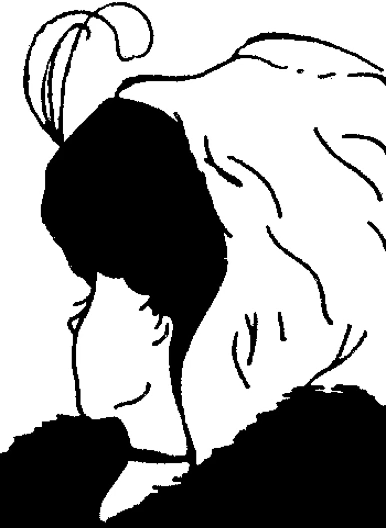
The illusion above has two perspectives: an old woman and a young woman. How is that possible? Nothing changes in the picture – but your perspective changes.
“We don’t see things as they are. We see them as we are.”–Anais Nin
But the same illusion holds true for “real” life. A child of nine and an adult of ninety perceive a woman about thirty-years old. One sees an old woman and one sees a young woman. One sees a rather short woman and one sees a rather tall woman. Multiple other differences occur because of the ‘inner logic’ from which the individual perceives. Find out why.
Consider this as a way of becoming. An egg is fertilized and the fetus begins to develop. The brain when it first develops has no neural network, except for the first development of a series of survival instructions, which are called epigenetic rules or instincts. These rules began with the very first species of single cell organisms called prokaryote, but are solidified in the DNA of the second such species – the eukaryote. Other than these minimal rules, the brain has no neural networks and will not create one until the species thinks!
Since thinking has no clear definition, we cannot say in what species thought first occurs, however, I would suggest that at some rudimentary level, even prokaryote think. Some mechanism occurs in response to some experience that indicates that the experience is life threatening and the organism responds; a decision is made – based on an assessment of a sensation that leads to a more organized perception: an interpretation of all the sensory data – first level thinking?
Let us jump to the human situation, as we know it today. We know that the fetus at some point in time has experiences (i.e. first level thinking) and then begins to assess the experience. The first level of this assessment has to do with utility or fitness. Is the experience helpful or harmful – bring more pleasure or more pain? Let us imagine that this first experience is a bump to the mother’s stomach – how is that bump interpreted. The degree of jolt or pressure may give the fetus the impression of something to be sought or avoided, but without any ability to respond, this ‘thinking’ cannot be carried much further. However, a second experience, perhaps another bump more or less jolting, gives the fetus a second parameter for assessment. Along with utility (pleasure/pain) the organism can now consider association: a comparison. Was this experience the same as or different than the first experience? And is this comparison a good thing or a bad thing? A judgement or decision is made.
We interrupt this story to ask the question – how many experiences does an entity have in one year of life? Obviously an unanswerable question; every word is experienced. However, we know that human beings have so many experiences that s/he does not consciously take in all of them. This is why two different people neither perceive an experience as the same things nor interpret a single experience in the same way.
Having established this fact, the next step in the story is that the organism must not only assess the utility and compare the experiences and decide upon a response (all thoughts), they must begin to try to understand the meaning of all these experiences. Despite your probable expectations, none of these experiences has any meaning at all, until the organism gives it meaning. The organism chooses the meaning of the experience by creating a context for it.
For the first four to seven years of life, the human child is interpreting experiences and putting them into a context, for there can be no meaning without context. Each experience provides data that is organized to produce a hypothesis that can be tested. In a more or less scientific exploration, the organism creates a meaning puzzle piece and fits it into the puzzle.
This ‘bottom up’ process provides vast amounts of data in exponential context, until finally, the organism creates a ‘theory’, which includes a perspective of the world, his/her place in it, and his/her relationship to all others people, places and things. This Theory of Meaning becomes the covert or ‘inner logic’ from which the individual makes his or her choices.
It should be obvious, that it would not be possible for any two people, even identical twins to have the same theory of meaning. But once the theory is solidified, the organism also creates a bias towards confirmation of what they already believe – their ‘inner logic’. The once, ‘bottom up’ process now becomes ‘top down’ and every experience is compared to the theory. There is ‘wiggle’ room – some experiences will be easily assimilated while others require accommodation. Some will be rejected while others will not even be recognized as existing.
Within the context of this Theory of Meaning, is an extensive store of interpretive information (thoughts) regarding spheres or points of interest, called schema. While there are conventional or pragmatic schema such as everything you know about restaurants, these are usually not the ones that cause problems in living. Of those potentially problematic schemata are the Self Schema, which includes thoughts about yourself and the Other Schema, which includes thoughts about what you think about others and what you think others think about you. You have come to the conclusion through your puzzle construction that you are: good/bad, ugly/handsome, smart/dumb, (Personal constructs – see George Kelly) etc. & etc. Further you have decided through the same process that people know you are good/bad, ugly/handsome, smart/dumb, etc. and respond accordingly. Finally, these beliefs lead to your Expectation Schema about the future success or failure in tasks and life (Locus of Control – Rotter).
Further, these self, other, expectation schemata lead to ‘attitudes’ that proliferate into personalities. It is interesting to note that people with problems in living often reprocess the same relationship difficulties over and over again. I have likened it in the past to Chaos Theory and attractors – Watch a creek as the water runs past a rock (the attractor) the water will swirl at each iteration with a remarkable similarity of patterns; never the same, but also not very different.
These thoughts and attitudes are the attractors that often make life a reiteration of itself. Those with the most positive schema seem to always be mostly happy and those with the least positive schema seem to always be unhappy. The presence of the Confirmation Bias makes change difficult, but not impossible. But before we talk about change, let us explore the brain and thinking. We stated earlier that the early brain had no neural networks except for ‘instincts’. Where then do neural networks come from? Each thought requires a network. Those networks that are rarely used tend to desensitize and dissipate. Those that are heavily and habitually used tend to become automatic. An automatic thought is like other automatic actions such as blinking and breathing. We can control them, but we don’t often even notice them. Unfortunately, thoughts that are negative by general rule are more often automated than thoughts that are positive. ‘I am stupid’ much more likely to be automated than ‘I am bright’, although I am sure we all know someone who thinks they are brighter than every one else, who is surprised when someone call him or her on it.
Consciousness is thought by Bernard J. Baar (A Cognitive Theory Of Consciousness – 1988) to be available for ‘debugging’ an automated system. When something is totally learned, it becomes automated. When a basketball player is ‘in a zone’, s/he is playing automatically. If s/he makes a large number of baskets in a row, s/he may become conscious of that anomaly and therefore disrupt the flow and start to miss. On the other hand, if s/he misses a large number of shots, s/he will be encouraged to ‘go back to the fundamentals’ – or think consciously about each movement and practice that until s/he gets it right.
In the same way, if thoughts are automatic, you need to bring them to consciousness and scientifically explore their validity. Because of the aforementioned Confirmation Bias, you may need a psychological mirror (counselor) to help get to a new truth.
Because we now know about the fact that each thought has a neural network and that some thoughts have a negative impact on your ability to function effectively, it is important to realize that your Theory of Meaning was begun and carried out for at least four years before your left side brain became dominant. Because of this there are no words to describe those intuitive right brain quirks that are the very foundation of your theory of meaning and reality. So if your problems in living are persistent enough, you may need professional help – not to control your behaviors, but to deeply explore your quirks.
But all of this is underlined by the fact that you programed your brain. Each thought is interwoven into a neural network of the brain, but the Mind (an emergent quality) assessed, compared, judged and decided what is good/bad, etc.; and through this process created a reality in which you live.
And the Mind can ‘debug’ the system if it can bring the critical issues into consciousness. The professional cannot help you decide differently, but s/he can help you consider such a decision. But what you think is purely up to you. Even violent dictators like Stalin cannot make you believe something you choose not to believe – even though they may be able to make you act as though you do. You can choose to be different and continue with your problems in living or you can choose to change your thoughts, beliefs and theory of meaning.
It is a matter of perspective. If some one bumps into you and knocks you down – how many different reasons can you think of that this might have happened? Interestingly, the more reasons you can think of the better. What is the maximum number of ways the illusion of a single experience can be perceived; there is no way to know. I have arbitrarily chose 64, based on a physicist and a Buddhist monk, who both appear in the same book – The Roots of Consciousness by Jeffery Mishlove.
“Fa Tsang [643-712], the Chinese master of Hwa Yen Buddhism prepared for the Empress Wu an octagonal room completely covered with mirrors, including the floor and ceiling. In the center he placed an image of the Buddha with a burning torch. He brought the Empress into this room and said [in part].
Your Majesty, this is a demonstration of the Totality in the Dharmadhatu. In each and every mirror within this room you will find the reflections of all the other mirrors with the Buddha’s image in them. And in each and every reflection of any mirror you will find the reflection of all the other mirrors, together with the specific Buddha image in each, without omission or misplacement. The principle of interpenetration and containment is clearly shown by this demonstration. Right here we see an example of one in all and all in one – the mystery of realm embracing realm ad infinitum is thus revealed. The principle of simultaneous arising of different realms is so obvious here that no explanation is necessary. The infinite reflections of different realms simultaneously arise without the slightest effort; they just naturally do so in a perfectly harmonious way ….
As for the principle of the nonobstruction of space, it can be demonstrated in this manner….[saying which, he took a crystal ball from his sleeve and placed it in the palm of his hand]. Your Majesty, now we can see all the mirrors and their reflections within this small crystal ball. Here we have an example of the small containing the large, as well as the large containing the small. This is a demonstration of the nonobstruction of ‘sizes’, or space.
As for the introduction of times, the past entering the future and the future entering the past cannot be shown in this demonstration, because this is, after all, a static one, lacking the dynamic quality of the temporal elements. A demonstration of the nonobstruction of times, and of time and space is indeed difficult to arrange by ordinary means. One must reach a different level to be capable of witnessing a ‘demonstration’ such as that. But in any case, your Majesty, I hope this simple demonstration has served its purpose to your satisfaction.
Notice that the suggestion of a need for a ‘different level’ to explain the temporal aspects of the mystical experience is a suggestion that reality is hyperdimensional”.
Because of the second story, I have suggested that Fa Tsang had placed 63 mirrors – each with its own perspective of the Buddha, but only after seeing all 63 perspectives does a 64th crystal ball perspective appear and you are enlightened.
The second story appears in both the body of the book and the appendix. As it is written by a physicist, I have much less understanding of it, but I give you a taste.
[The physicist Saul-Paul Sirag] “finds that unified field theories of the physical forces depend fundamentally on mathematical structures called reflection spaces, which are hierarchically organized in such a way that an infinite spectrum of realities is naturally suggested.
The central postulate of Sirag’s paper is that this seven-dimension reflection space is a universal consciousness, and that individual consciousness tap into this universal consciousness.
In fact, the seven-dimensional reflection space is contained in an eight-dimensional reflection space, and contains a six-dimensional reflection space, so that there would be a realm of consciousness directly ‘above’ ordinary reality, and realm of consciousness directly ‘below’ ordinary reality.
I think that is probably enough for most of us; those not satisfied can get the book. Somewhere Sirag mentions the number 63 and mirrors that I arbitrarily then use as my standard. But what do we mean by perspectives and reality? Reality for you is based upon your theory of meaning – there is no other reality. A substantial part of this reality is the same as most other people – generally we rely on the fact that ‘the sun will come up tomorrow’ – but we don’t always agree on what this means. For any experience, we must ask the question: ‘Is this a good thing or a bad thing?’. We will often disagree in our judgements about that depending upon our perspective. But further than this, we decide to what degree we believe it is good or bad. This scalar decision places value on the judgement. If it is terribly good or bad, we have very strong values for it. If it is moderately good or bad, we are less invested. And if it is neither good nor bad, we have no investment at all.
We invest in all kinds of things and some investment cause us pain. Hate is a particular deadly emotion and that negative is not limited to the hate object. If you hate, you erode your own serenity – the state that most people are in when they are satisfied and happy. Love can also cause us pain; particularly if unrequited. This is what the Buddha meant when he suggested that attachments are the cause of suffering. But any state can change if the thinking changes.
There is a wisdom story about a man in a boat at night who sees another boat coming towards him. He yells to alert the other boat and tries to move out of the way. But the boat rams him and almost dumps him into the water. In anger, he lets loose a slew of expletives at the top of his voice into the night. As he calms down, he realizes the other boat is empty. His thinking about the incident changes almost immediately as he grins to think of who might have heard his outburst and what they might have thought.
But why has his thinking changed? The other boat still hit him and almost dumped him. The situation is still the same but the context has changed. Like the illusions on this site the lines remain the same, but something different is seen. The story of the man’s changing response is an illusion of a cognitive quality. The man in the boat saw two of the perspectives out of 63. Let the illusions be a lesson to you.
Below you will see a material illusion. I am told that it holds eight perspectives, although I have only perceived six. The cognitive illusion, according to my arbitrary standard is eight times as complex, so cognitive change is as simple as turning on a switch, but it is not easy.
The materials on this site are all oriented toward helping you see the other parts of the illusion.
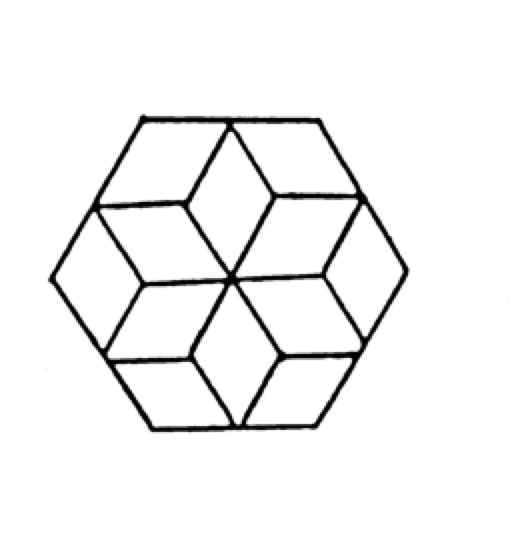
As with a material illusion, much is hidden from you; particularly those quirks for which there are no words. But you can improve through words, visions, emotions and sensory feeling, as well as spacial placement.
A simple change in thought process is demonstrated by the phrase (overt or covert) “I can’t”. In almost all cases it should be thought of as “I won’t”. The phrases I can’t lose weight or stop smoking, usually mean: I am not willing to do what is necessary to lose weight or stop smoking. There is more cost than I am willing to pay. Below we indicate how the helping professions often add to this cost benefit analysis through their insistence that you must stay mentally ill or addicted since it is a ‘disease’. There is no scientific documentation for that conclusion.
The present state of the art of human services (medical model) is demonstrably destructive and has been a documented failure for over sixty years. Those ‘experts’ in the field cannot even see, hear or understand (you have ears, but you do not hear) because their theory of meaning is so skewed. They have tried various means to make the metaphor of ‘illness’ become a reality, but it does not work because it is not true.
A simple cause and effect confusion is relevant to consider. If you are terribly afraid and in a panic; your adrenaline rises. Did the adrenaline cause the fear or did the fear cause the rise in adrenaline? You work it out. However, I will direct you to consider the reason for the rise in adrenaline.
We also know that you can control your brain chemistry through meditation of biofeedback – so why do they insist on toxic medications? Because it keeps them in power.
You are the sum total of what you think. “If you think you can or you think you can’t, you are right!” (attributed to Henry Ford).
If you think people are out to get you, this is your reality and no persuasion or medication is going to change that fact. In fact, these ‘command and control’ tactics taken ‘for your own good’, are a destructive atrocity that often supports the ‘inner logic’ that is causing the problems.
I have probably not spent enough time talking about the messages you have received which provide a context for your decisions about your theory of meaning. Certainly other people, particularly those of importance to you have a major impact on how you think about experiences or situations. But this is not the most powerful force in the universe – you still control your mind. Unfortunately, all statements are true, until you take the time and energy to properly evaluate them. Time and energy are often strained, and therefore, if I can make a proposition to you while you are under stress, you may simple accept it. However, you can always come back and question.
Professionals cannot change you – but they can help you change, if only they would open their eyes and wash their ears. But even those calling themselves cognitive therapists are vulnerable. They want the prestige of the doctors and use destructive terminologies and methods. If your cognitive counselor suggests that you suffer from a diagnosis or that you might take medication, they should be avoided. The adage, buyer beware would be applicable if you were paying, but in the coercive model in which we live, someone else usually pays and you have limited choice.
Some of your concerns may be helped with the self-help techniques on the site depending on how seriously you are hurting. For serious hurt, the search for appropriate help may be difficult, but at least this site can help you hone that search.
For those counselors, teacher and other helpers out there, please understand, that your reality, although perhaps more functional, is no more real than your client’s reality. If you have been pulled in by the expert medical model, you may need to correct not only your thinking, but your language as well. This is difficult, and as with the illusions – first discovery may not last. It takes time and repetition to avoid old thoughts and words. Don’t be too hard on yourself, but always self-correct – even though your former colleagues will not understand.
So what have we accomplished here? Each individual creates his or her own reality, which has common elements with others, but is only approximate. The creation of one’s reality is based upon billions of experiences and interpretations and is affected by perception, assessment, valuation, and the perspective of important others. The foundation of this reality is built while only a child and is, generally ineffable. Like icebergs in the sea, only a limited view of the belief system of ourselves and others is available to consciousness. You cannot even begin to articulate what you believe.
The real test of this reality is based upon its functionality – if it leads to mutual and satisfying relationships, it is probably pretty sound. If it leads to problems in living, it probably needs work. The good news is that the technology to work on your theory of meaning is available. The bad news is that few professionals are able to use it to help either themselves or other.
This at least is my reality as I see it.
Jerome R. Gardner 2017